The Game Studies journal uses a basic with its overall design, which can make reading a bunch of long articles boring, no matter how interesting the subjects are. In terms of digital journals, I will say I expected a lot more from the majority of them. In concept, yes they are all digital journals, but the intergradation of technology could go so much further. For example, when I think of digital journals, the Verge is a prime model of what I would picture it like. Using the functions of technology to make it interactive with the user, and ignoring restrictions like the cost of ink it would take to print thousands of copies. I found these two journals to be polar opposites of each other, from their designs to their content. Even with both of them sharing a similar theme with articles about technology. The Verge does cover more topics overall, giving it more of a news type outlet by posting frequently about current issues and topics. Whereas the Game Studies journal is very sparing with the articles they post for a certain topic (mainly focus on computer games). Due to the infrequently, the authors are able to go into detail and depth for articles.
eng333
Blog Post 3/3
Academic:
1. Computers and Composition Online: http://cconlinejournal.org/
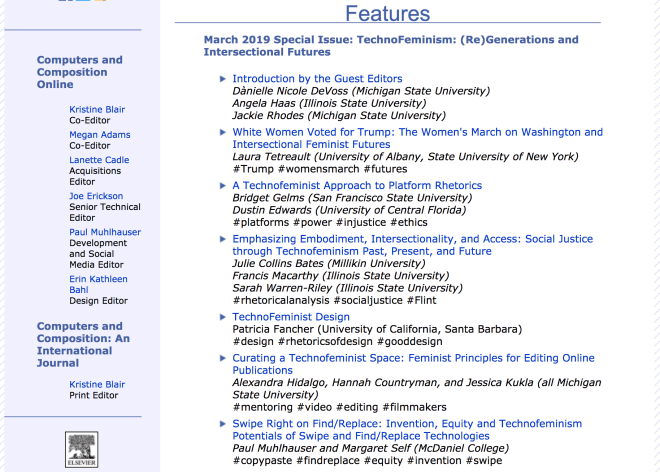
This journal is one of the older ones, turning 33 years old this year, and 15 of those they have been digital. The overall design and layout does reflect age of the journal with its basic layout and color scheme. Still it dictates itself as a resource for scholars interested on the media’s impact on the voices for writing online.
2. Game Studies: http://gamestudies.org/1502/
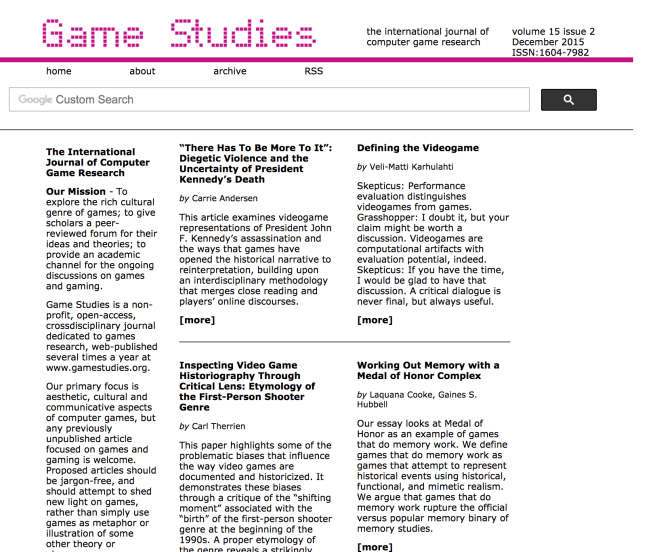
Game Studies is a journal that uses peer-reviewed forums in order to discuss topics of games and gaming in an academic environment. What makes this interesting is that; although it is an academic journal, it says that articles should be jargon-free. This makes it easy for anyone to read the journal and get into the concept of games. The journal’s design itself is a little boring and has not been changed since the first volume in 2001.
3. Games and Culture: http://gac.sagepub.com/
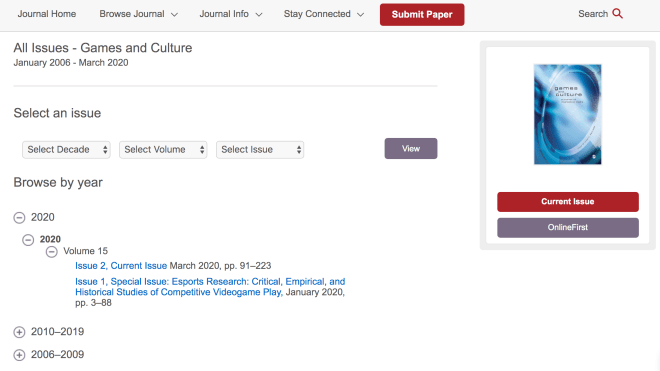
This journal explains its purpose as creating an academic dialogue about the design, development and research a game may cause. As well as examining how games may be used for things other than entertainment, such as education. For example, being trained for the military in a game is an interesting take on gaming
Non-Academic:
4. Bitchmedia: https://www.bitchmedia.org/
This publication caught my eye because of the name of the website. Bitchmedia describes itself as, “a feminist response to pop culture” and “unapologetically independent.” Unlike the academic journals, this publication uses multimodal platforms such as print, digital and podcast. They aim for all demographics of women in order to encourage feminism as a “part of the broader social justice movement.”

5. Huffington Post: https://www.huffingtonpost.com/
I choose to explore Huffington Post because I have heard of it before. Although it is considered a news site, I always thought it was a questionable one. During my time on the site, I it took me a whole to find the about section. There was a link at the very bottom that forced the reader to skim all of the articles titles before reaching the bottom. The about section explained that they are opinion based, and focus on writing about the people’s experience. Opinion and facts are the opposite of each other, which explains my hesitance with using the Huffington Post.

6. The Verge: https://www.theverge.com/
This publication is by far the one that uses the most visuals and colors. Unlike the Huffington Post, the Verge makes it statement of achieving integrity for their journals very clear, and out in the open. The purpose of the Verge is to study how the future of technology will change mainstream audiences. They post often and stay up to date on popular trends, such as YouTube and Fortnite. As I was looking into publications, I saw many on the coronavirus and health concerns followed Fortnite news, showing the broad topics it has.

2/18 Blog Post 2
1. Rhetorical Sovereignty: “The rights and responsibilities that students have to identify their own communicative needs and to represent their own identities” (Selfe 618).
Selfe wants to empower the students to think on their own to find their own style. Finding their style means that they should be made aware of different mediums for their communication as tools they would be able to use in the future.
2. Aural Text: “They often found the texts of television and radio, which involved the aural presentation of information, to resonate more forcefully than the written texts of historical eras” (Selfe 631).
Aural can be simply defined as sound, which traditionally is the opposite of text. Using the two together creates a juxtaposition, but even so has been shown to reinforce the information. This could be used as a powerful tool for teachers in their classrooms.
3. Digital Networks: “Have provided routes for the increasing number of communications that now cross geopolitical, cultural, and linguistic borders” (Selfie 367).
Our world is a digital one and to understand aural/written literacy, understanding digital communication is necessary. Since people from different classes, races, and power have access to digital technologies, it has affect literacy across the world. Large organizations do not only just use print as a means of communication, but other mediums as well. Digital networks help to establish a connection between people with common interest.
2/18 Blog Post 1
Selfe argues that by following the traditional learning process, it limits the understanding of the world and other resources that have become available. Like the multiliteracy and other articles, Selfe claims that print literacy goes against voicing other’s culture. In order to change the tradition, the author believes both writing and aurality must be taught in school. Although there are topics that aurality should focus on like music, the history of it always comes back to the writing of it, such as looking at the written song lyrics.
Many cultures are coming together in this digital age. Examples of this are the United Nations, Human Rights Watch and International Olympics Movement, who use various communications beside text. As technology advances the use of it increases, in order to establish communities that crosses cultures. Selfe references the New London Group, “who identified the aural as one modality among many” (638). They allowed for composition in the classrooms to become more expressive, although only a small portion of it was accepted. The importance behind using technology is so that students are able to understand what their options are, and that they should not be limited by their teacher’s way of thinking.
2/13 Blog Post 1
Yancey struggles to define what writing is, and how much it actually covers. Like the multiliteracies article and George’s article, Yancey credits technology for changing how writing’s definition is defined. As public reading and writing grew more popular, there began a mixture of class, gender, ethnicity coming and functioning together as a whole. With this though, Yancey explains there is a decline in English departments at schools and higher education itself. This is because it is becoming part of our daily lives without having to go to school for it. Yancey gives the example of language used in cinema which has become common vocabulary. From this brings up the next topic of how composition should be taught. For the most part, teachers have already moved onto using digital literacy.
Even so, Yancey argues that there must be three major changes made to education to teach composition. The first is developing a new curriculum, then revise the current curriculums writing style and finally developing a major in composition and rhetoric. The new curriculum should focus on the writer to the world, rather than how it is set up currently with the writer to teacher. Because of the growth of technology, writing to an individual rather than a group is no longer reasonable. It can create some good writers, but using the same method as when there was no technology does not prepare the students for the future.
2/13 Blog Post 2
1. Reading Circles: “sites of domestic engagement, but also in public places” (Yancey 300).
Yancey talks about the concept of public reading and the parallel effect it had on writing. By the 21st century, much like reading circles, writing circles had come to be with the aid of technology. These writing circles were very diverse but still it is important to see how they acted together without instructions, because they are willing to write without looking for a reward such as a grade.
2. Digital Divide: “Many of us continue to focus on print. Given a concern that postmodernism and infobits could undermine a sustained rational discourse” (Yancey 307).
Technology advancements have been credited in each article for changing how literacy can be portrayed as. The issue with this is that many of the older generation does not want to change the way they teach because they do not fully understand the digital world. Although many classrooms do already use digital literacy, the curriculum does not reflect on this.
3. Deicity of Technology: “Deixis, linguistically, whose ‘meanings changes quickly depending on the time or space in which they are uttered’ or read” (Yancey 318).
Deixis is a word used to describe something that is always changing depending on the context. Because of the effect of technology, literacy has also become deixis. Meaning that there is more room for expanding composition itself such as in media. It is important to be able to adapt to a new process to prepare for the future.
2/11 Blog Post 1
Diana George talks about the importance of visuals in the classroom. They are not trying to define what makes something visual literacy, but instead argue that “the visual and the verbal are the same, are read or composed in the same way, or have the same status in the tradition of communication instruction” (George 14). George uses the history of media and talks about the neglect it got within classrooms until cultural theory came into play. A connection to the multiliteracies articles to this article is the idea and influence of design on writing. The idea of text being a visible language relates back to the idea of composition and how it should be designed. Much like text, a webpage or movie should also be coherence and have a navigable design for example. Understanding the benefits of visuals and their structure can be a powerful resource for students and their future with a technological world.
 ENG/WRI333