The Game Studies journal uses a basic with its overall design, which can make reading a bunch of long articles boring, no matter how interesting the subjects are. In terms of digital journals, I will say I expected a lot more from the majority of them. In concept, yes they are all digital journals, but the intergradation of technology could go so much further. For example, when I think of digital journals, the Verge is a prime model of what I would picture it like. Using the functions of technology to make it interactive with the user, and ignoring restrictions like the cost of ink it would take to print thousands of copies. I found these two journals to be polar opposites of each other, from their designs to their content. Even with both of them sharing a similar theme with articles about technology. The Verge does cover more topics overall, giving it more of a news type outlet by posting frequently about current issues and topics. Whereas the Game Studies journal is very sparing with the articles they post for a certain topic (mainly focus on computer games). Due to the infrequently, the authors are able to go into detail and depth for articles.
digital publications
3/17 Blog Post
Right off the bat, the Verge is very eye catching and makes used of various visuals and popping colors against a black background on the homepage to standout. The purpose of the Verge is to study how the future of technology will change mainstream audiences. Therefore, the articles found are very up to date and target the tech savvy population with drop down tabs for things such as “tech” and “creators”.

They use many types of modality on their website in the forms of newsletters, podcasts and videos. Clicking the video tab on the menu bar will which actually just send you to their YouTube channel, but they also have videos all around the website that can be clicked and sent to the article that goes with the video.

3/5 Blog Post
The academic journal I choose to look into more was the Games Studies, who define their purpose as shining light onto games and gaming. Although they say they welcome all types of games, they focus mainly on computer games. While I was reading through I archives, I found many theories on the general ideas of games as well as specific games such as Pokémon Go. Out of the 10 journal entries I read, eight of them had abstractions. On the other hand, all of them gave credit to their author’s on the left side, as well as background on their qualifications giving a very creditable feel.
Originally, I choose my major of computer science hoping to enter the gaming industry. Although my passion for working at a gaming company has decreased, I still enjoy games and what they are all about, so to me the journal had interesting concepts. The journal had many interesting entries and ideas, but the overall appearance of the site and articles are boring. Some did make use of visuals, but there was still an overwhelming amount of text to read comparatively. As far as navigating the journal, because of its basic design it is easy to find what you want. The only part where I became confused was knowing what volume of the journal I was in, since the only change from volume is in the right hand corner.
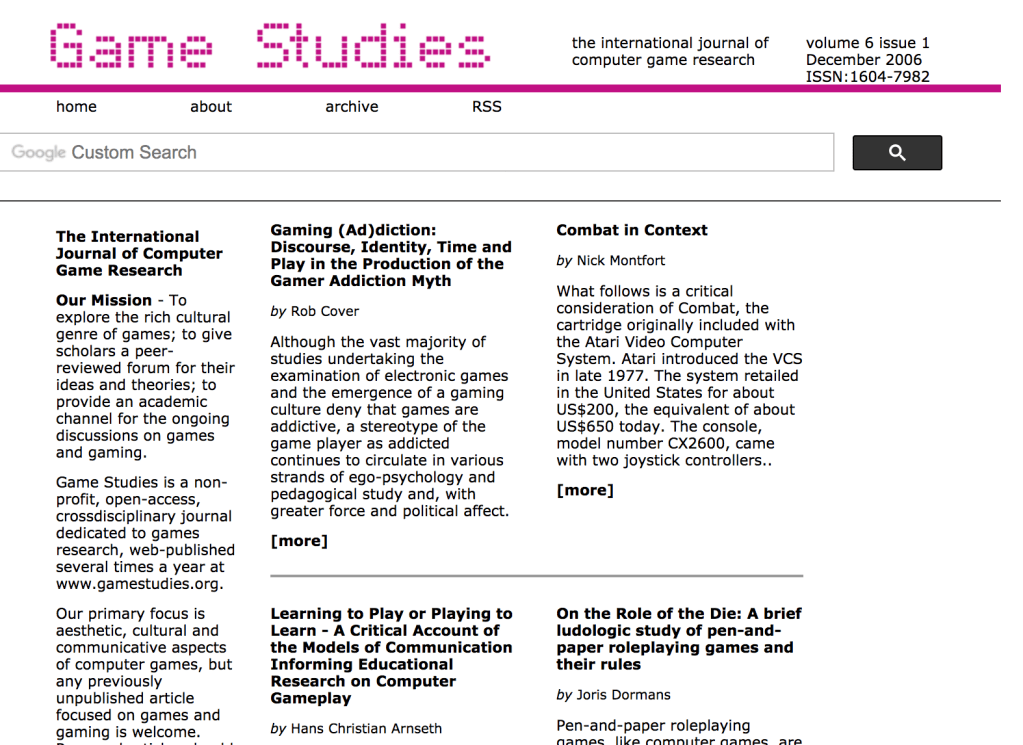
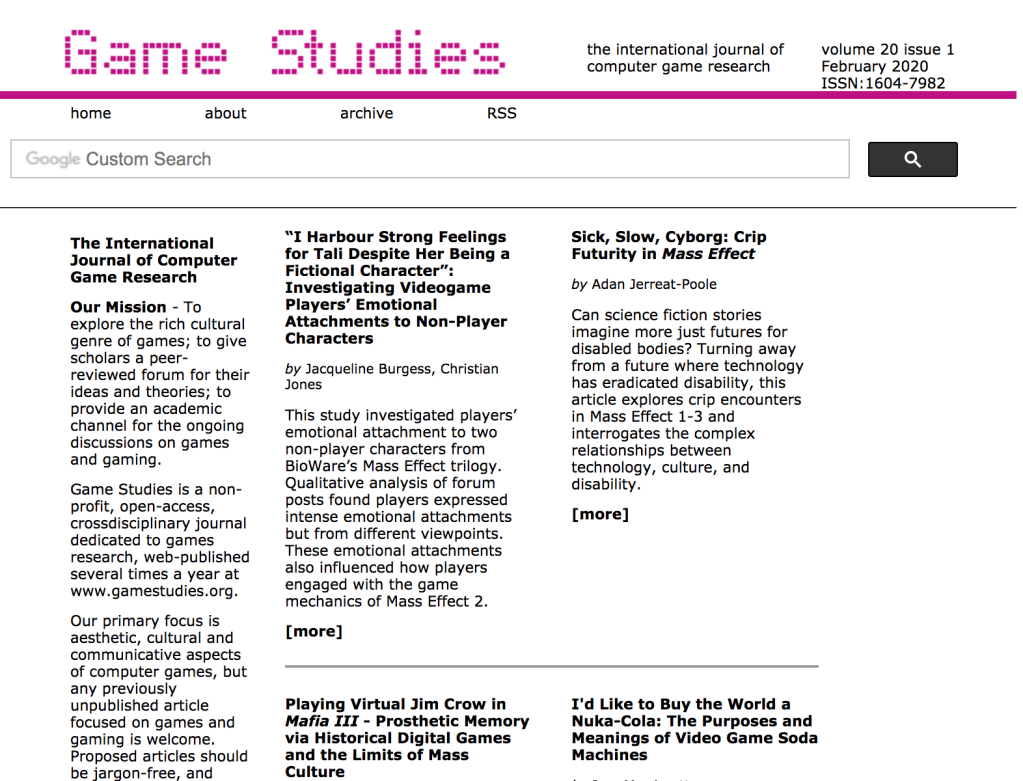
Blog Post 3/3
Academic:
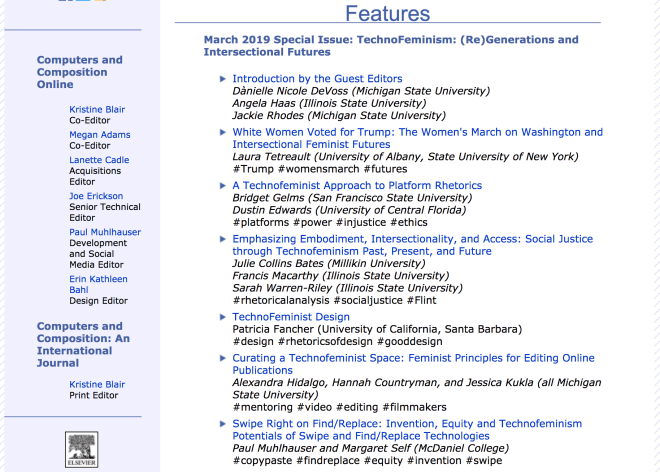
1. Computers and Composition Online: http://cconlinejournal.org/
This journal is one of the older ones, turning 33 years old this year, and 15 of those they have been digital. The overall design and layout does reflect age of the journal with its basic layout and color scheme. Still it dictates itself as a resource for scholars interested on the media’s impact on the voices for writing online.
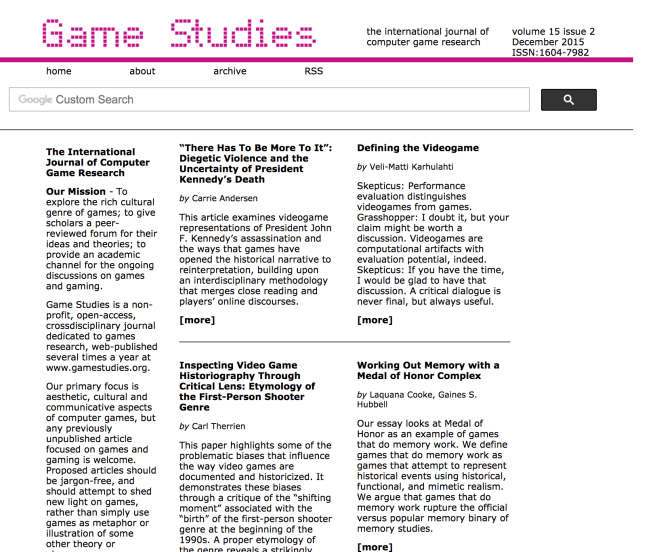
2. Game Studies: http://gamestudies.org/1502/
Game Studies is a journal that uses peer-reviewed forums in order to discuss topics of games and gaming in an academic environment. What makes this interesting is that; although it is an academic journal, it says that articles should be jargon-free. This makes it easy for anyone to read the journal and get into the concept of games. The journal’s design itself is a little boring and has not been changed since the first volume in 2001.
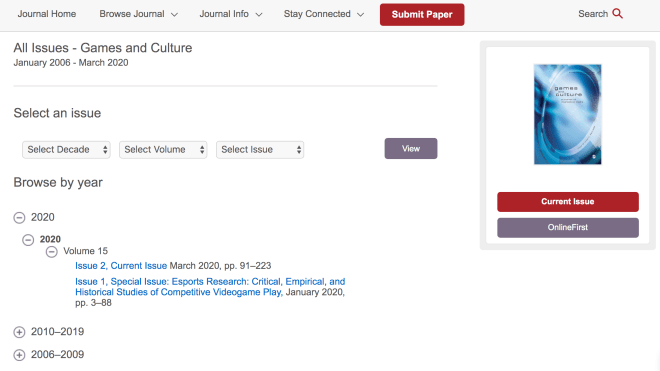
3. Games and Culture: http://gac.sagepub.com/
This journal explains its purpose as creating an academic dialogue about the design, development and research a game may cause. As well as examining how games may be used for things other than entertainment, such as education. For example, being trained for the military in a game is an interesting take on gaming
Non-Academic:
4. Bitchmedia: https://www.bitchmedia.org/
This publication caught my eye because of the name of the website. Bitchmedia describes itself as, “a feminist response to pop culture” and “unapologetically independent.” Unlike the academic journals, this publication uses multimodal platforms such as print, digital and podcast. They aim for all demographics of women in order to encourage feminism as a “part of the broader social justice movement.”

5. Huffington Post: https://www.huffingtonpost.com/
I choose to explore Huffington Post because I have heard of it before. Although it is considered a news site, I always thought it was a questionable one. During my time on the site, I it took me a whole to find the about section. There was a link at the very bottom that forced the reader to skim all of the articles titles before reaching the bottom. The about section explained that they are opinion based, and focus on writing about the people’s experience. Opinion and facts are the opposite of each other, which explains my hesitance with using the Huffington Post.

6. The Verge: https://www.theverge.com/
This publication is by far the one that uses the most visuals and colors. Unlike the Huffington Post, the Verge makes it statement of achieving integrity for their journals very clear, and out in the open. The purpose of the Verge is to study how the future of technology will change mainstream audiences. They post often and stay up to date on popular trends, such as YouTube and Fortnite. As I was looking into publications, I saw many on the coronavirus and health concerns followed Fortnite news, showing the broad topics it has.

2/27 Blog Post
From what I can understand, Kairos is a low acceptance rate journal targeted mainly towards scholars with an interest in digital rhetoric. It uses an interesting concept of peer reviews, and has a reputation for being academically trust worthy.
The overall design of the journal is key catching, to the point where I almost found it overwhelming compared to the traditional/standard format. The landing page stands out with its inverse color scheme compared to a normal website, aided by colorful headers for the articles. Each of the articles on Kairos have their own style, showing the diversity of it. Some use visuals, while others rely mainly on the text with a few imagines every once in a while.
The context on Kairos itself seems to be focusing on digital rhetoric in the sense of teaching authorship and rights for online composition. Originally, copyrights were not an issue because everything was in a physical copy. The digital communication allowed for the spread of work online for anyone to use with just a simple search to find. It is important that credit is given when due, and because of this Jiang argues for a model of ownership. Although this can be messy when the creator is not just a human. It brings up the concept to crediting the tools for the creation of the work. Although some laws have changed, it is still under debate who to credit ownership with.
As the Kairos journal has gone on through the years, we can see the growth in technology about it. Pointing out key ideas, such as the use of multimodal composition. Originally, the issues were much more formal. Following the standards students learn throughout school giving it basic style, and without much to look.
 ENG/WRI333